
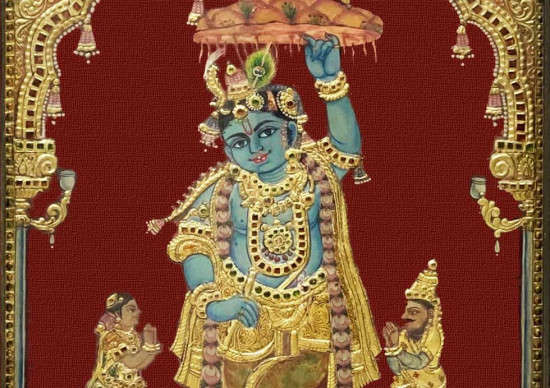
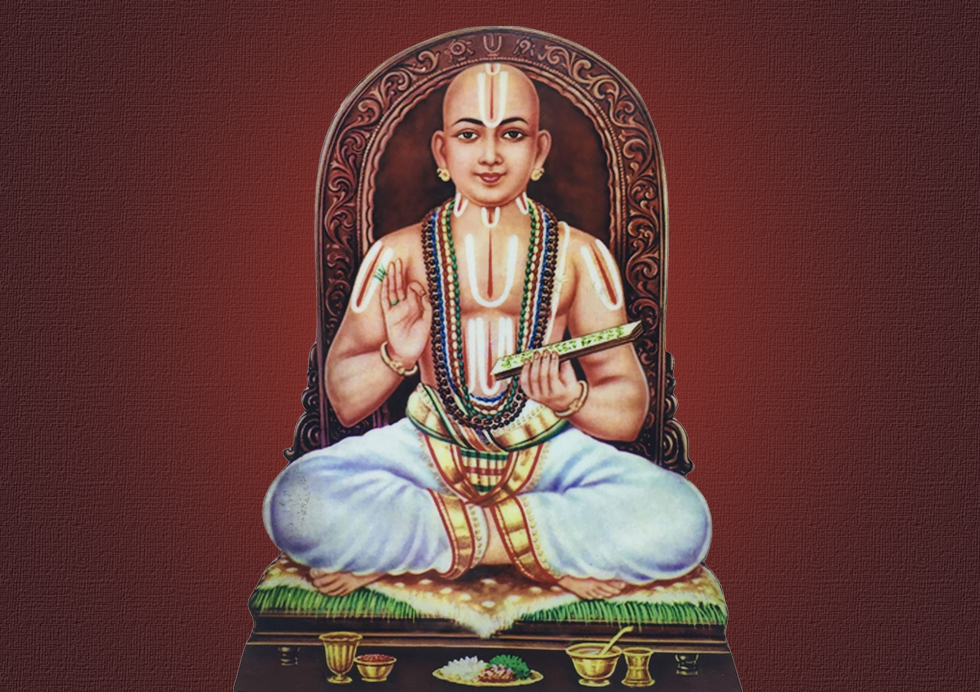
Ask a Sri Vaishnava family about Vedanta Desikan, and you will hear his name spoken with deep respect. Climb the Tirumala hills, and you will hear the name of Lord Venkateswara called out by thousands of pilgrims. A story that starts before Desikan was even born links the two names. This blog explains the bond between Vedanta Desikan and Lord Venkateswara, who Desikan was, why the Lord mattered to him, and how the Lord’s form is carried into idols made for temples and homes.
Who Was Swami Vedanta Desikan?
Swami Vedanta Desikan, also known as Vedanta Desika, was a teacher and a poet. He was a philosopher of the Sri Vaishnava tradition. He was born in 1268 CE in Thoopul, a village near Kanchipuram in present-day Tamil Nadu. His childhood name was Venkatanatha. His parents, Anantasuri and Totarmba, gave him this name. Later, people gave him the honorific name Vedanta Desikan, which is usually understood to mean the supreme teacher of Vedanta, the philosophy found at the end of the Vedas.
Furthermore, he followed Vishishtadvaita, the school of Ramanuja. In simple terms, it teaches that god, souls, and the world are all real, and that souls find their purpose in loving and serving god. Desikan explained and defended this view in Sanskrit, Tamil, and Manipravalam, a style that mixes the two.
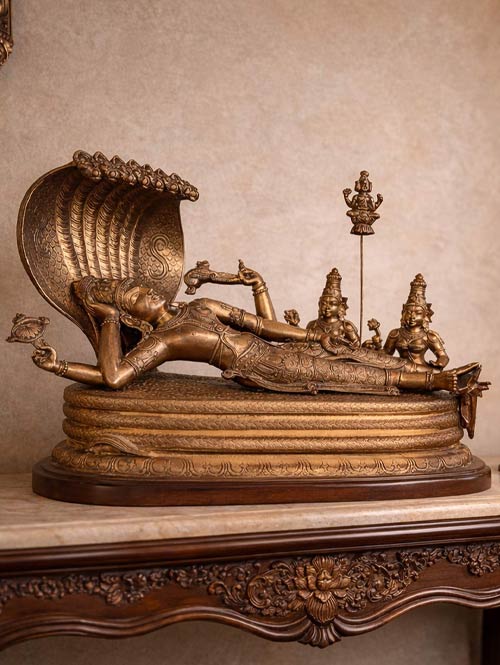
Vedanta Desikan History at a Glance
| Detail | Information |
|---|---|
| Born | 1268 CE, Thooppul near Kanchipuram |
| Birth name | Venkatanatha |
| Parents | Anantasure and Totaramba |
| Teacher | Kidami Appullar (Atreya Ramanuja), his maternal uncle |
| Philosophy | Vishishtadvaita |
| Later life | Settled in Srirangam |
| Passed away | Around 1369 CE, aged about 101 |
Swami Vedanta Desikan Life Story
The above-discussed story comes from biographies written within the Sri Vaishnava tradition. His maternal uncle, Kidambi Appullar, supervised Desikan's schooling. At a very young age, he was recognized as a gifted scholar. He married Tirumangai, also known as Kanaavalli. Vedanta lived a simple life and accepted little for himself. He used to travel on foot to give lessons in several towns. Later, he settled in Srirangam.
In the early 1000s, someone attacked Srirangam. It was a dark period in his time. Later on, traditional accounts say Desikan left, helped protect the temple’s deity and a precious commentary, and returned once the two were safe. He returned with the intention of restoring worship. Swami Vedanta Desikan's life history reflects his devotion to Lord Vishnu and his contribution to Sri Vaishnavism. He was also a skilled sculptor, a craft with its own traditional techniques, which makes his bond with sacred images feel personal.
How Vedanta Desikan and Lord Venkateswara Are Connected
Vedanta Desikan and Lord Venkateswara share a special place in stories about the saint’s devotion to the Lord and his connection with Tirumala.
The Bell Legend
The Bell Legend
One such story is that, according to Sri Vaishnava tradition, Anantasure and Totaramba went to Tirumala to pray for a child. Totaramba is said to have dreamed of the temple bell of Lord Venkateswara, and people believe Desikan is that bell, born as a human. The connection between Vedanat Desikan and Lord Venkateswara is a devotional belief. Still, it explains why he bore the Lord's own name, Venatanatha, and why people often compare his teaching to a temple bell.
Dayasatakam: A Hymn to the Lord of Venkata Hill
Dayasatakam: A Hymn to the Lord of Venkata Hill
Desikan was a poet and philosopher. His own writing shows his bond with the Lord. His Dayasatakam has 100 Sanskrit verses on divine mercy. It opens by bowing to Venkata Hill, where the temple stands. The daya in Dayasatakam means kindness or divine compassion. Apart from this, many stories say Paduka Sahasram is another renowned work that praises Lord Ranganatha of Srirangam. So the Dayasatakam stands out as his tribute to the Lord of Tirumala.
Lord Srinivasa: Who is Lord Venkateswara?
Many people search for this question. Lord Srinivasa and Lord Venkateswara mean the same deity. They are both forms of Lord Vishnu, who is worshipped at the Sri Venkateswara Temple in Tirumala, Andhra Pradesh. Venkateswara means Lord of the Venkata Hill, the seventh peak of the Seshachalam range. Srinivasa means the one in whom Sri, or Lakshmi, lives. Devotees also call them Balaji and Govinda.
According to popular tradition, Lord Vishnu came to Earth as Srinivasa. He was married to Padmavati, a form of Lakshmi. He took a loan from Kubera for the wedding. Today, the temple is managed by the Tirumala Tirupati Devasthanams.
How a Lord Venkateswara Statue Shows His Meaning
Sculptors follow a set form when they make the Lord, whether it is a carved wooden statue, a carved stone statue, or a bronze statue of Hindu gods. Every detail of a Lord Venkateswara statue, from the conch and discus to the hand gestures, carries a meaning connected with the deity.
| Features | What It Shows |
|---|---|
| Conch and discus | Held in the upper hands as the signs of Vishnu. |
| Lower right hand | In varada mudra, the gesture of granting boons. |
| Lower left hand | Rests on the thigh in katyavalambita mudra. |
| Crown, tilak, and jewels | Recall the offering that kings and devotees made to him. |
| Prabhavali | The carved arch behind him, which frames him like a shrine. |
| Chest | Tradition places images of his consorts Sridevi and Padmavati here. |
Bringing Lord Venkateswara Home with Cottage9
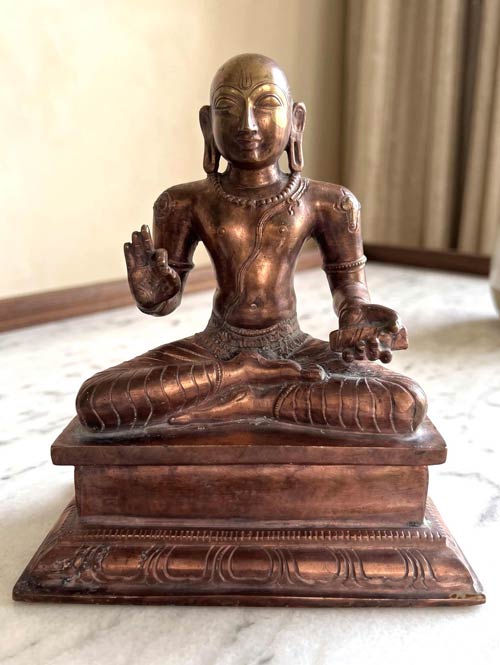
Cottage9 has pieces for both figures in this story. The Vedanta Desikan bronze idol is cast by the lost-wax method and shows him in a meditative pose with one hand raised in blessing. Its compact size suits a prayer room or study table. For the Lord himself, the Vishnu Venkateswara art print reproduces a painting by S. Rajam. It shows Venkateswara alone, with the conch and discus in his upper hands, one lower hand in varada mudra, and the other resting on his thigh.
Additionally, you can also look at our vintage Padmawati Devi print. It follows a design that the Tirumala Tirupati Devasthanams once sold as prints, and shows his consort holding lotus flowers in her back hands. To read about her, see our guide to Padmavati Devi.
Final Thoughts
Vedanta Desikan and Lord Venkateswara show how scholarship and devotion can meet in one life. Vedanta Desikan’s history is placed firmly in the 13th and 14th centuries, while the bell story is a cherished belief that gives it meaning. Swami Vedanta Desikan life story inspires many devotees with his teachings. Ultimately, whether you read Dayasatakam or place a Lord Venkateswara statue in your prayer room, the aim is to keep that relationship close. For painted sacred art, see Cottage9’s Tanjore paintings, and for daily worship, browse brass statues and metal puja items.
Frequently Asked Questions
When is Vedanta Desikan’s birth anniversary observed?
Vedanta Desikan’s Tirunakshatram, or birth star day, falls in the Tamil month of Purattasi under the Shravana star. Devotees note that Shravana is also the birth star of Lord Venkateswara, so the two observances share a link.
How many works did Vedanta Desikan write, and in which language?
More than 100 works are attributed to him, and India Post’s 2019 stamp notes give 170. He wrote in Sanskrit, Tamil, and Manipravalam, covering philosophy, poetry, hymns, commentaries, and arts and science such as sculpture.
Which places are linked with Swami Vedanta Desikan life story?
Besides Thooppul, he lived in Kanchipuram, Thiruvahindrapuram, Srirangam, and Melkote, and spent time at Satyagala near Kollegal. He also visited Tirupati and, by several accounts, travelled across India on foot.
What titles did Vedanta Desikan receive?
Tradition says Lord Ranganatha and Ranganyaki Thayar honored him as Kavitarika Simha, meaning lion among poets and debaters, and Sarvatantra Svatantra, meaning master of every school of thought. Both titles appear in traditional biographies.
Why is Lord Venkateswara called Kaliyug Varada?
Kaliyug Varada means the wish-granting Lord of the Kali Yuga, the present age in Hindu thought. Devotees believe he answers the prayers of people living in this age. It is one of the many forms of Lord Srinivasa.